Home and business security are changing fast as smart technology becomes part of everyday life. Traditional locks and keys alone no longer provide the confidence many owners want, especially with modern threats and busy schedules. Smart and digital access control systems add an extra safety layer beyond basic entry. They help manage who can enter, when access is allowed, and how each entry point is monitored. This provides greater control and visibility for doors, gates, and garage entries, especially when paired with proper garage door opener installation to ensure secure, reliable access at all times.
Smart access systems also support smarter security decisions in real time. With features like activity logs, remote unlocking, temporary digital keys, and alerts for unusual attempts, these tools actively work to keep risks at bay. Instead of just reacting to problems, smart access helps prevent issues before they grow. That is why smart access is becoming an essential part of how many properties are managed and protected today.
Understanding Smart Access as a Safety Layer
Smart access lets you control exactly who can enter your home and when. Instead of relying only on traditional locks, these systems use connected technology at every entry point, from the front door to the garage. That makes it much harder for an unauthorized visitor to get inside. With smart access, door locks, and a smart garage door opener, you can monitor and manage a larger home security system in real time.
Once you understand how smart access works, it becomes clear why it adds such a strong safety layer. These systems offer activity logs, remote control, digital keys, and alerts that older setups cannot match. Tools like a smart garage door opener help close gaps in home security, so your property is protected more consistently and with far better control.
If you want a deeper view of the larger shift behind these upgrades, read “Why Are Homeowners Switching to a Smart Garage Door Opener Faster Than Ever?”
What Makes Smart Access Different from Traditional Security Solutions
The biggest difference between smart access control and traditional security systems is that you no longer depend on physical keys. Keys are easy to lose, steal, or copy, which can create serious safety issues. If a key goes missing, you often have to rekey multiple locks, which can cost time and money.
Smart access systems remove that problem. Entry points can be opened with a mobile app, a PIN code, a key card, or even biometrics, such as a fingerprint scan. If you need to change access for a guest or service provider, you can update or remove their entry rights instantly from your phone or computer, without touching the locks.
Digital security systems also give you far more control. You can grant temporary access for specific hours or days and review activity logs that show who entered and when. Smart access control makes it easier to manage your home, helping you feel confident that your security setup is organized, up to date, and responsive to your needs.
For more context on why older systems fall behind modern expectations, check “Why Traditional Openers Feel Outdated for Today’s Homes.”
How Smart Garage Door Opener Technology Enhances Home and Community Safety
Your garage is one of the main entry points to your house, which makes secure access control essential. A smart garage door opener strengthens this area by helping prevent unauthorized entry and supporting a safer home environment. With smart access technology, the garage becomes part of a wider smart home security system that helps protect your family and property every day.
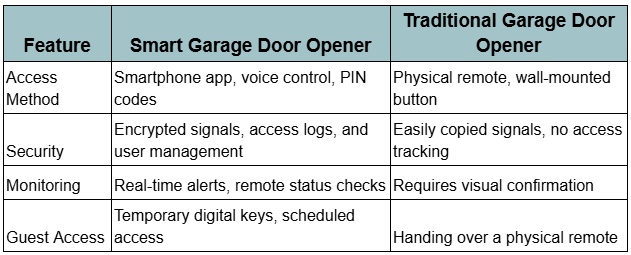
A traditional opener relies only on a handheld remote. A smart garage door opener, however, connects to your home’s Wi-Fi and works through a smartphone app. You can check whether the door is open or closed, receive alerts when it opens or closes, and feel more confident about home security even when you are away.
Key safety features include:
- Granting temporary or scheduled access for deliveries and guests without sharing a physical key
- Receiving real-time notifications whenever the garage door opens or closes
- Integrating with other security systems, such as cameras, for complete visual confirmation and stronger monitoring
Core Features That Set Smart Access Systems Apart
The strength of smart access lies in features designed to meet today’s security expectations. A modern access control system does much more than unlock or secure doors—it gives you real awareness and control over every entry point. These tools help you stay informed, respond quickly, and manage access with greater confidence across your property.
Two of the most important features are real-time alerts and remote management. Together, they make your security system faster, easier to use, and far more reliable than older options. These capabilities help ensure that your smart access system supports both everyday convenience and enhanced home protection.
To see how these instant updates and app controls improve daily security, read “Real-Time Alerts and Remote Control Homeowners Want Now.”
Real-Time Alerts and Continuous Monitoring Capabilities
Smart access control stands out for delivering real-time information about your entry points. You do not have to guess whether a door is left open or worry about who may be trying to get in. The system sends alerts straight to your phone whenever an access event happens, so you can respond quickly if a potential security threat is detected. This is exactly what many homeowners mean when they talk about the real-time alerts and remote control they want now.
With smart access, you also gain continuous monitoring across your property. These systems often work together with video surveillance, allowing you to open a live camera view the moment an alert appears. If an unauthorized entry attempt occurs, you can see it in real time. This combination of alerts and video creates clear evidence and stronger peace of mind.
Key access control features include:
- Instant alerts for all successful and failed entry attempts
- Notifications when a door or garage remains open longer than a set time
- A complete activity log with dates, times, and locations for every authorized entry
At its core, MFA layers something you have, something you know, or something you are, so entry doesn’t hinge on a single lost key, shared PIN, or copied code.
Remote Control and Access Management for Everyday Convenience
Being able to manage your property’s security from anywhere is a major advantage for homeowners and property managers. Remote access means you are not tied to your home or building to keep it secure. If you need to let in a guest, allow a repair professional to enter, or lock a door you forgot about, you can handle it instantly through your phone.
Mobile apps make this possible. These tools let you manage smart locks, smart garage door openers, and every entry point connected to your system. From a single app, you can add or remove users, set access schedules, and review detailed activity logs. This streamlined setup improves everyday use and makes access management much easier.
This level of control simplifies daily life. You can keep your home protected while on vacation or manage entry for on-site teams at your business without being there. It offers a strong balance of security and convenience for anyone who wants clear, reliable control over smart locks and access through remote management.
How Smart Access Improves Security for Houston, TX Homes and Businesses
In a busy city like Houston, TX, homeowners and businesses need stronger, more dependable security measures. The access control market is shifting toward smart access solutions because they offer better protection and easier daily operations. These systems enhance safety for families, employees, and property managers, helping ensure only authorized individuals enter secured areas. They can even support connected entry points, such as an emergency garage door, providing users with quick access during urgent situations while maintaining high security.
For large properties, multi-unit buildings, or commercial spaces with frequent foot traffic, smart access control delivers a higher level of security than older systems. It helps address safety challenges common in a growing city by giving you clear oversight of who enters and when they enter. Property managers and business owners benefit from the added efficiency, while homeowners appreciate the flexibility and real-time insight.
Blocking Unauthorized Entry with Advanced Authentication
A main goal of any access control system is to prevent unauthorized entry, and smart access solutions achieve this effectively through advanced authentication methods. Instead of relying only on physical keys—which can be lost, copied, or stolen—these systems use secure ways to verify identity. Smart access control systems verify who a user is, what they know, or what they carry, making it far more difficult for an intruder to gain access without permission.
Biometric authentication is one of the strongest examples. It uses physical traits such as fingerprints or facial recognition, which are extremely difficult to duplicate. This provides powerful protection at key entry points in both homes and commercial properties.
Advanced authentication methods include:
- Biometric authentication: Uses unique traits, such as fingerprints or facial recognition, for identity verification.
- Mobile credentials: Allow entry via a smartphone using Bluetooth or NFC, without relying on physical keys.
- Multi-factor authentication: Requires two or more verification methods, creating a stronger and more secure access process.
Internet-connected devices carry inherent cybersecurity and privacy risks if not adequately secured, as noted in a guide from New York State’s Office of IT, which recommends separating smart home devices on their own Wi-Fi network and regularly updating device firmware.
Addressing Security Challenges Unique to Texas Properties
Many Texas properties are large and come with their own security challenges. Wide lots, multiple structures, and gated entries can be difficult to manage with older methods. Handling every gate and door separately takes more time and is not always effective. Smart access systems offer a single, organized way to control all these entry points at once, allowing you to monitor everything from a single dashboard.
With smart access, you can install smart locks on gates, sheds, and sensitive areas such as equipment rooms. All these locks operate under the same access control system, so only approved users can enter. This helps reduce the risk of theft or property damage and makes daily oversight easier for property managers who manage multiple locations.
Smart access systems can also be supported by battery backup. If the power goes out, which can happen during storms or outages in Texas, the system continues to run. That means the property stays secure even when electricity is down, solving a common weakness found in traditional electronic systems.
Comparing Smart Garage Door Openers to Conventional Options
When you compare a smart garage door opener to conventional models, the difference in security and convenience is clear. Traditional openers handle basic up-and-down operation. Modern smart garage door openers go much further by offering controlled access, activity tracking, and remote management that better match how homeowners live today. This added control is a major reason many homeowners now choose a smart garage door opener instead of keeping an older unit.
The access control market has changed significantly. Homeowners expect more than a simple button for entry; they want detailed monitoring, remote operation, and smooth integration with other smart devices. Features such as real-time alerts, app control, and links to cameras or alarms make smart garage door openers an appealing upgrade. As you compare your options, these differences can help you decide when it is the right time to move up to a smarter system.
Why Today’s Homeowners Are Upgrading Their Garage Door Opener
Today’s homeowners are upgrading their garage door openers to gain enhanced security, greater convenience, and greater peace of mind. A smart garage door opener fits easily into a connected lifestyle by turning your smartphone into a secure remote control. This integration allows you to manage one of your home’s largest entry points from almost anywhere, whether you are at work, traveling, or relaxing at home. Remote access, real-time alerts, and encrypted signals make everyday use safer and more reliable than what conventional openers can offer.
These upgrades are part of a broader shift toward smarter, more efficient homes. A smart opener can be linked to access control systems and automated routines that improve overall home management. For example, you can create rules to ensure the garage door closes at night, receive instant alerts for package deliveries, or sync the opener with smart lighting. These features help homeowners streamline daily tasks while boosting home security and operational efficiency.
Common Signs It’s Time for Garage Door Opener Repair or Replacement
An older garage door opener can do more than make daily use annoying—it can also weaken home security. Knowing the warning signs helps you decide whether a garage door opener repair is enough or if it is time to upgrade to a smart garage door opener with smart access control. When the opener struggles, stops randomly, or still depends on outdated security codes, one of the main entry points to your home may be easier to access than you realize.
Ignoring these issues can place your home at risk. An opener that works only sometimes may leave the garage door partly open, and older units with a single, unchanging code are easier for an intruder to copy. Upgrading to a modern system can help the door move more smoothly and add stronger protection with encrypted signals, real-time alerts, and better access control.
Here are common signs to watch for:
- The opener is very noisy and creates grinding, straining, or shaking sounds while running.
- The garage door moves slowly, gets stuck, reverses with no clear reason, or opens and closes on its own.
- The opener has limited security features and still uses an old remote with one unchanging code that can be copied easily.
Adapting Smart Access to Different Property Types
One of the strongest advantages of smart access control is how flexible it is. These systems are not designed as a single setup for every situation. Instead, they can be tailored to match almost any property type—from a single-family home or townhouse to an office building or large business park. Smart access lets you define security levels, manage entry permissions, and monitor access points so the system fits your exact needs.
For property managers, this flexibility makes it easier to handle building operations and stay ready for compliance checks. Smart access control can be configured for shared entrances, private areas, parking gates, and service rooms, all from one platform. As your property grows or you add more units and facilities, the system can scale with you, supporting new access points without needing a complete redesign.
Multifamily and Gated Communities: Streamlined Access Without Compromise
Managing entry in multifamily buildings and gated communities can be challenging when you rely on regular keys. The workload grows quickly with many residents, guests, and vendors using multiple doors and gates. Smart access control simplifies this by offering secure, convenient entry options. Residents no longer need physical keys or fobs. Instead, they can use smartphones to open gates, enter buildings, and access shared amenities.
Smart access also makes visitor management far easier. There is no need to meet guests at the gate or lobby. Residents can send a digital pass through an app that only works for the time and areas allowed. This flexible access system supports residents while giving property managers clear control over who can enter. Detailed access data helps with planning, security oversight, and long-term operations.
Key benefits for multifamily and gated communities include:
- Streamlined visitor access: Digital passes that work only for the needed time frame.
- Centralized control: Property managers can grant or remove access instantly from one platform.
- Detailed audit trails: Each entry point records when and how access was used, supporting stronger security and clear accountability.
Scalability for Growing Commercial and Residential Needs
As security needs change, your access control system should be able to grow with you. One of the strongest advantages of smart access control is its scalability for both homeowners and business owners. Whether you add another commercial building to your portfolio or create an in-law suite on your property, a modern smart access system can extend coverage to these new areas without major changes.
Smart access lets you manage every building from one centralized, easy-to-use platform. You can add new doors at any time, organize user groups, and assign each group only the access they require. This keeps entry rules consistent across all locations and makes it simple to onboard new team members or adjust permissions for different departments in commercial buildings.
Because the system is designed to expand, your original investment continues to deliver value for many years. You do not need to install a completely new setup every time your property grows. Instead, smart access control helps keep long-term costs manageable while strengthening protection as your residential and commercial needs increase.
Smart access systems have become an essential part of home security, not just a nice upgrade. With real-time alerts, remote access, and stronger control over entry points like the garage, they offer a safety layer that traditional garage door openers cannot match. A smart garage door opener helps you manage access, monitor activity, and feel more confident that your home is protected every day.
Premium Garage Door Repair can help you upgrade to a smart garage door opener that fits your security needs and daily routine. Our technicians can inspect your current setup, recommend practical options, and handle a quality installation. If you would like to learn more or schedule a visit, contact us or give us a call today to get started.
Frequently Asked Questions
Why is smart access control considered an essential safety layer in modern buildings?
Smart access control is important because it helps you manage every entry point with ease. It provides real-time updates, instant credential changes, and clear audit trails. Unlike older systems that only watch activity, smart access control lets you take action fast, improving daily operations and giving stronger protection for modern buildings.
How does smart access control improve security compared to conventional systems?
Smart access systems eliminate the risks associated with physical keys, such as losing them or having copies made. You can turn off access immediately if needed, helping block unauthorized entry. With advanced options like biometrics and secure mobile credentials, smart access offers stronger and simpler security than older setups.
What are the main benefits of using smart access systems in workplaces?
Smart access boosts workplace efficiency by making it easier to manage who enters each area. It integrates with business tools and keeps accurate logs for compliance. Security teams can assign permissions, reduce manual tasks, and maintain better control with less paperwork. This leads to smoother operations and more peace of mind.
What features should I look for in a smart access control system?
You should choose a system with real-time alerts, remote access through a mobile app, and options such as PINs or biometrics for stronger identity checking. Make sure it connects with your other security devices and manages all doors from one dashboard to keep monitoring and daily access control simple and reliable.
Is smart access technology suitable for multifamily residential buildings?
Yes. Smart access is ideal for multifamily properties because it simplifies visitor management and removes the need for physical keys. Property managers can control all entry points from one system, improving both convenience and security for residents and staff.
What are the top reasons to switch to smart access in my office?
Smart access strengthens security with advanced identity checks, improves workflow through automation, and lowers long-term costs by eliminating rekeying. Security teams also benefit from better data, easier monitoring, and the ability to make changes from anywhere.
How do smart access systems contribute to physical security?
These systems help block unauthorized entry using smart locks and authentication tools. They track who enters and when, providing a full activity record. When combined with video surveillance, they give clear visual confirmation and stronger control over every access point.
Are smart access control systems scalable for business growth?
Yes. Modern smart access systems are built to scale. You can add new users, doors, or entire locations while managing everything from one platform. This flexibility means you can expand without replacing your system.
What is a smart access system?
A smart access system controls who enters and exits a building using digital or mobile credentials. Managers can adjust permissions from anywhere through software, and the system connects with other security tools to improve overall protection.
Is a smart door lock safe for the home?
Yes, smart door locks are generally safer than traditional locks. They use encrypted technology, tamper alerts, and detailed entry logs. Since they do not use physical keys, there is no risk of losing or copying a key. These features help keep your home more secure.
Smart access control is important because it helps you manage every entry point with ease. It provides real-time updates, instant credential changes, and clear audit trails. Unlike older systems that only watch activity, smart access control lets you take action fast, improving daily operations and giving stronger protection for modern buildings.
Smart access systems eliminate the risks associated with physical keys, such as losing them or having copies made. You can turn off access immediately if needed, helping block unauthorized entry. With advanced options like biometrics and secure mobile credentials, smart access offers stronger and simpler security than older setups.
Smart access boosts workplace efficiency by making it easier to manage who enters each area. It integrates with business tools and keeps accurate logs for compliance. Security teams can assign permissions, reduce manual tasks, and maintain better control with less paperwork. This leads to smoother operations and more peace of mind.
You should choose a system with real-time alerts, remote access through a mobile app, and options such as PINs or biometrics for stronger identity checking. Make sure it connects with your other security devices and manages all doors from one dashboard to keep monitoring and daily access control simple and reliable.
Yes. Smart access is ideal for multifamily properties because it simplifies visitor management and removes the need for physical keys. Property managers can control all entry points from one system, improving both convenience and security for residents and staff.
Smart access strengthens security with advanced identity checks, improves workflow through automation, and lowers long-term costs by eliminating rekeying. Security teams also benefit from better data, easier monitoring, and the ability to make changes from anywhere.
These systems help block unauthorized entry using smart locks and authentication tools. They track who enters and when, providing a full activity record. When combined with video surveillance, they give clear visual confirmation and stronger control over every access point.
Yes. Modern smart access systems are built to scale. You can add new users, doors, or entire locations while managing everything from one platform. This flexibility means you can expand without replacing your system.
A smart access system controls who enters and exits a building using digital or mobile credentials. Managers can adjust permissions from anywhere through software, and the system connects with other security tools to improve overall protection.
Yes, smart door locks are generally safer than traditional locks. They use encrypted technology, tamper alerts, and detailed entry logs. Since they do not use physical keys, there is no risk of losing or copying a key. These features help keep your home more secure.